I.
For AI developers
Safety, robustness and reliability evaluations before deployment. An external, documented, defensible assessment.
Evaluate a system →“Science without conscience is but the ruin of the soul.”
Independent evaluations of AI systems
RabelAI evaluates AI systems independently and rigorously, for the companies that build them, the regulators who oversee them and the researchers who study them.
The same protocols, the same standards, three ways in.
I.
Safety, robustness and reliability evaluations before deployment. An external, documented, defensible assessment.
Evaluate a system →II.
Protocols aligned with European requirements, and results that are legible enough to inform public decisions.
Work with us →III.
A think tank on the beneficial development of AI: notes, analyses and positions grounded in our measurements.
See public results →Four areas of work
01
Resistance to misuse and circumvention, with its cost in production.
02
Cognition, learning, dependence, sense of agency: effects studied empirically.
03
Work, culture, the production of knowledge: transformations already under way.
04
Proposing and evaluating solutions: chosen friction, transparency, cultural adaptation.
Method
No financial ties to the developers we evaluate. Our conclusions are not negotiable.
Documented, versioned, re-runnable protocols. Every score can be traced back to its source.
Public methodologies, explicit limitations. What we don't measure is stated as clearly as what we do.
Data hosted in Europe, a framework designed with the AI Act and its General-Purpose AI Code of Practice in mind.
First reference evaluation
Specialized guardrails or frontier LLMs acting as supervisors: which ones best detect misuse, at what cost and with what latency? The first independent operational benchmark of these systems.
The best specialized guardrails detect around 95% of harmful content, versus 94% for frontier LLMs, with false-positive rates of 2% or lower. They run 5 to 10 times faster and cost about 10 times less.
Frontier LLMs catch more attacks and raise fewer false alarms, but cost 10 to 50 times more, with 5 to 10 times higher latency.
In collaboration with

UK AI Security Institute
United Kingdom

CeSIA
French Center for AI Safety

SPAR
Supervised Program for Alignment Research
Why Rabelais
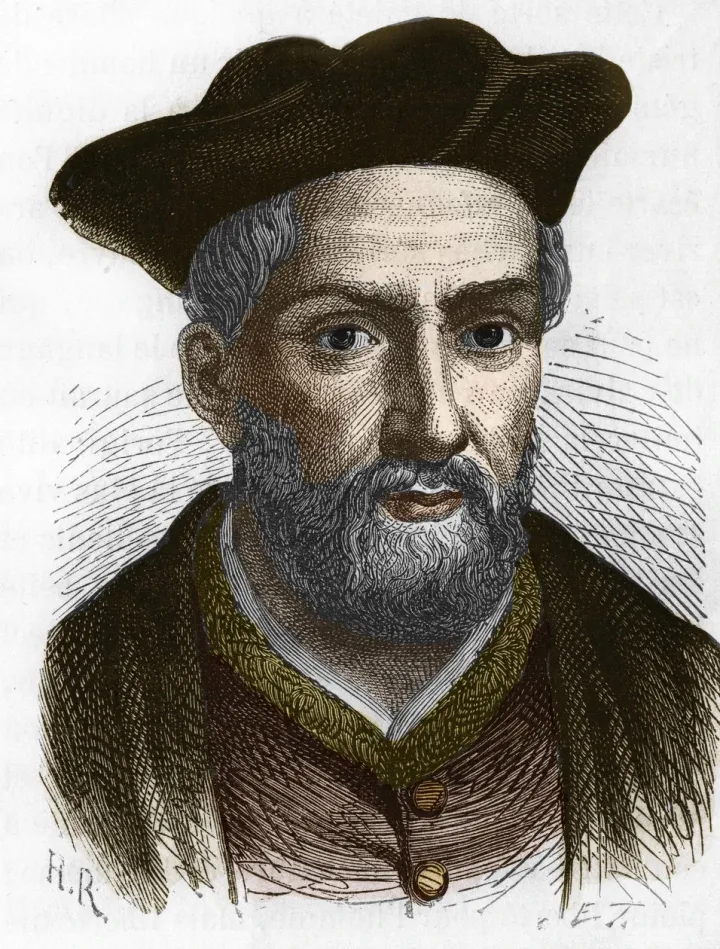
Physician, scholar and writer, Rabelais lived through the arrival of the printing press, a technology that multiplied access to knowledge. In Pantagruel, he reminded us that knowledge is only worth something when guided by conscience.
Five centuries later, AI asks the same question at a different scale. RabelAI exists so that measuring capabilities is never separated from reflecting on their effects.
A system to evaluate, a public decision to inform, a research project: a first thirty-minute conversation to discuss it.